A story of health sovereignty, culture and the next great chapter of the Torres Model of Care
By Tom Hearn – Waibene
The sea around Mer Island is a deep and restless blue. It moves with a rhythm older than memory, pulling stories up from the ocean floor and laying them gently across the sand. These stories hold everything – the birth of Torres Strait law, the Mabo struggle, the power of land and language, the weight of family, the silence around suffering, and the wisdom of women who carry more truth in a single conversation than most systems manage in a decade.
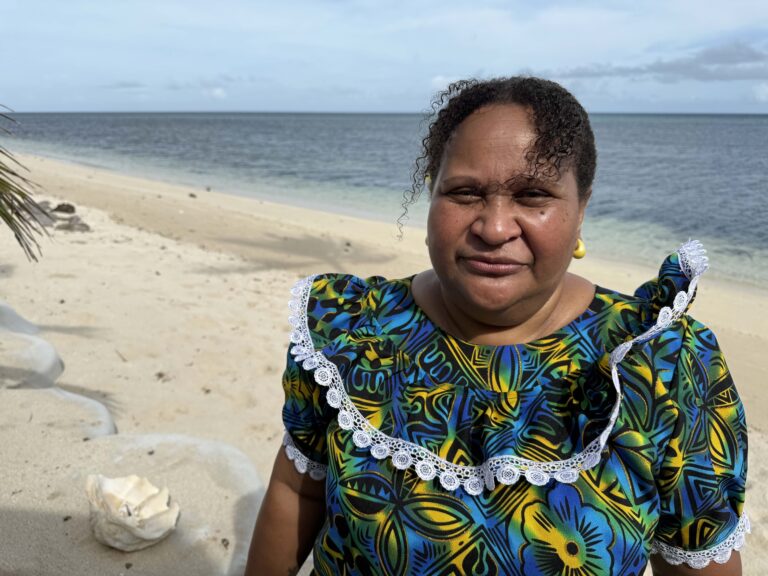
One of those women is Aunty Melora Noah of Mer.
When Aunty Melora speaks, her words come slowly and with purpose, carried by the tide of generations. There is nothing hurried in her way of thinking. She speaks from the centre of something much larger, a worldview shaped by law, faith, family, and an unbroken lineage of Meriam knowledge. Sitting with her feels like sitting in an old canoe that knows every current and every reef beneath you.
We came to Mer for Aftercare consultations, but what unfolded in her yard was not an interview. It was a profound exchange, a lesson in sovereignty, reform, and the unfinished story of wellbeing in the Torres Strait.
The silence within
Aunty Melora began not with policies or funding but with the truth that lives inside every home. Mental health challenges, she said, are everywhere. They sit quietly in families, shaping how people talk, or choose not to talk, about pain. For generations, some things have stayed behind closed doors. When depression or grief appears, people often look first to spiritual or family explanations – bad luck, punishment, something unsettled in the family.
That silence has deep roots. It is born from love and pride, but also from fear and shame. In small communities, the fear of judgement can stop people from reaching for help. Families handle it alone. “It’s always there,” she said, “but people don’t speak it.”
Across the Torres Strait, the data tell a similar story. Rates of psychological distress remain among the highest in the nation. The latest Closing the Gap report shows that suicide and self-harm hospitalisations for Torres Strait Islander peoples are several times higher than for non-Indigenous Australians, while access to culturally safe mental-health care remains limited. The numbers, though stark, cannot capture what Aunty Melora described – the quiet heartbreak of watching people struggle without trust in the services around them.
Beyond the centre
Her reflections turned toward the structure of health delivery itself. For too long, decisions have been made from a distance – on Thursday Island, in government offices, or through agencies that do not live the daily realities of the outer islands. Mer, Erub, Ugar – each holds its own laws, dialects, and rhythms of care, yet the system treats them as one.
Health sovereignty, in her mind, is inseparable from the sovereignty affirmed by Eddie Koiki Mabo. “If the land is ours,” she said, “then the care that happens on it must also come from us.” It was not anger that shaped her words but clarity – a simple truth spoken with the confidence of someone who has seen too much centralised decision-making to believe it works.
The Torres Model of Care and what comes next
The original Torres Model of Care, created under leaders such as Uncle Phillip Mills, was revolutionary. It drew its strength from culture, family, and the Lagaw Principles – guidelines grounded in respect, kinship, communication, spirituality, and place. It was, for its time, the first health model to recognise that Torres Strait Islanders did not need to be serviced. They needed to be trusted.
But time has changed. Families move between islands. Youth navigate both digital and cultural worlds. Chronic disease and mental distress now intersect with climate anxiety, economic hardship and cost of living, and the weight of colonisation’s residue.
Aunty Melora believes the model must evolve. Version one created a framework; version two must create place. Real healing, she said, will happen when we understand that our health is in our hands and health practitioners and educators, the ones equipping us with the necessary tools to make our own decisions, are our own people, the ones we share a meal with, the ones that stands in line with us at IBIS Mer. Real change can only come from within. cannot happen in fly-in fly-out clinics. It must live on the island, in spaces that belong to the people. Healing, she said, begins when the land and the sea, the people, and the service are one.
A centre that belongs
She pointed toward the new clinic on Mer – eight million dollars of concrete and glass. It stands proudly on the main street, a symbol of investment but not yet, in her view, a symbol of healing. “It’s a treatment place,” she said. “Healing is different. Healing is about sitting, talking, and listening. It’s about early prevention, not crisis care. It’s about family.”
Her vision is practical and poetic at once: to build a local Health and Wellbeing Centre on the vacant clinic carpark.. A space where prevention is the first language, where counsellors, cultural mentors, and community connectors work side by side with health experts and educators. A space where women can feel safe and where men can speak freely. “Every island,” she said, “should have its own Health and Well Being Centre like that, not just Mer. There must be a holistic approach to health where acute and preventative care work side by side.”
She sees Wakai Waian Healing as a key partner in this future, with the cultural credibility and the right elders to lead. The names of Uncle Pedro Stephen, Uncle Phillip Mills, Uncle Gabriel Bani, and Uncle Marsat Ketchell surfaced in her reflection – men whose combined wisdom, she said, “is the foundation for something new.”
Healing as sovereignty
Across the country, governments continue to promise transformation yet Closing the Gap data show that only a handful of national targets are on track and mental health is not one of them. In the Torres Strait, access to care still depends on weather, travel, and cost. For Aunty Melora, these are not just logistical barriers; they are remnants of colonial design.
Healing, she said, is not only about illness but about power – about who decides what care looks like. When that power returns to the people, that is when healing begins.
Her words echo the Mabo legacy. The island that redefined land rights is now calling for health rights. The island that proved ownership of country is now insisting on ownership of care.
The next chapter
As the afternoon light faded and the tide began to pull back toward the reef, her voice fell quiet. The wind carried the smell of salt and hibiscus through the yard. There was no speech left to make, only understanding.
Mer has always been the birthplace of change. It changed the law of the land. Now it is calling to change the way the nation heals.
Aunty Melora’s message is not a proposal or a plea. It is a direction – a map drawn from lived wisdom, urging us toward a future where health sovereignty stands alongside land sovereignty as the next great act of justice. The High Court of Australia already rubber-stamped Meriam sovereignty… ‘as against the whole world’. It is about getting the blueprint right and we need to start with healing. The architects of that blueprint, the People of the Mabo Decision, the Meriam People, must heal first..
It begins here, on Mer Mayem, with the ancestors watching, with community leading, and with culture at the centre.
It is time for the country to listen.