By Tom Hearn
When people talk about workforce shortages, they often talk in numbers. Vacancies. Ratios. Incentives. What is spoken about far less is the human journey that turns someone into a clinician who stays.
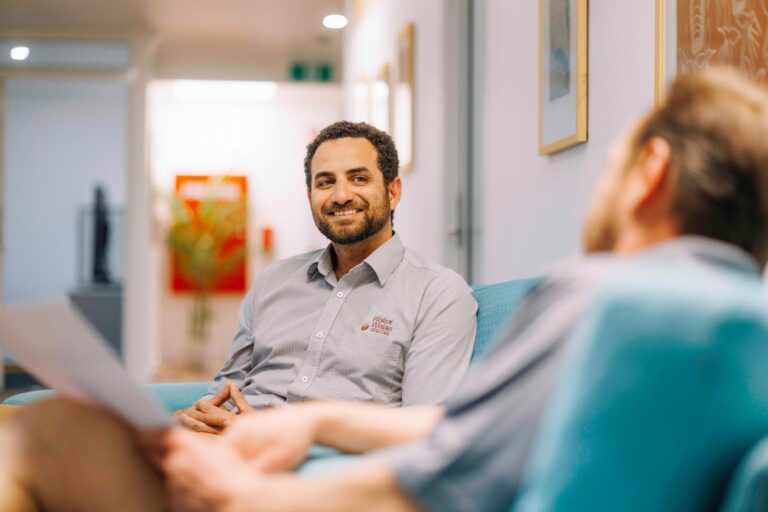
Luke Edmunds is one of those journeys. A proud descendant of the Darumbal people and an Australian South Sea Islander, Luke was born and raised in Rockhampton on Darumbal Country and in his final Honours year. He’s well on his way to becoming a psychologist. But the road hasn’t been easy.
Today, he leads Wakai Waian Healing’s service delivery team, has delivered extensive counselling and community work on Palm Island and across Western Queensland, and is preparing to graduate as a psychologist next year.
His story is not one of fast tracking or shortcuts. It is a story of persistence, responsibility and community grounded growth. “I didn’t come through the front door of education,” Luke says quietly. “I came the long way around.”
As a young man, Luke left school early. Like many First Nations men, he moved through different industries, construction, mining, small business and disability support, always working, always providing, but feeling a sense that something deeper was missing. It was not until 2017, when he enrolled in CQUniversity’s STEPS program, that higher education became possible. “That program changed my life,” he says. “It opened a door I didn’t think was meant for people like me.”
In 2022, Luke completed his Bachelor of Psychological Science. He is now completing his honors. But the degree alone did not define his direction. What shaped him was what came next.
Before returning fully to study, Luke worked in the Queensland Public Service supporting Indigenous children and families. The work was confronting. Removal, trauma, systemic pressure and ethical tension were part of everyday life.
“It was the hardest work I’ve ever done,” he says. “But it made something very clear to me. We need our own people in these roles. People who understand family, culture, grief and responsibility from the inside.”
When Luke joined Wakai Waian Healing, he entered an organisation that did not see him as a student passing through, but as a future leader to be held, supported and grown.
Under the supervision of Senior Psychologists Ed Mosby and Joe Sproats, Luke developed not only clinical skill, but the steadiness required to work in complex community environments. His counselling work on Palm Island and in Western Queensland has been characterised by consistency, trust and deep respect for local authority.
“Luke shows up,” says Ed Mosby. “Not just to sessions, but to community, to team, to responsibility. That matters more than anything.”
At Wakai Waian Healing, Luke now leads service delivery, supporting other clinicians, managing complex caseloads and helping to shape how care is delivered across regions. He does this while completing his honours year and preparing for provisional registration.
“Working alongside Luke, you see his commitment every day. He shows up prepared, thoughtful and steady, even in very complex situations. He doesn’t rush people, and he doesn’t cut corners. That consistency makes a real difference for both clients and staff” says Julyess Jarvis.
It is not easy. Luke is a father. His daughter is approaching graduation. His son is navigating early high school. Study, work and family all move together.
“My kids know why I do this,” he says. “They know it’s bigger than me. It’s about changing what’s possible for our mob.”
Luke is clear about the systems he is working within, and the ones he is pushing against. He speaks openly about organisations that profit from trauma without delivering lasting change, and about the frustration of watching cycles repeat because power remains elsewhere.
“There are people who are scared of what happens when our mob becomes strong, educated, financially independent and spiritually grounded,” he says. “But that is exactly what healing looks like.”
For Luke, psychology is not about fixing people. It is about restoring strength, autonomy and connection.
“Culture, spirit, family and evidence based practice are not opposites,” he says. “They belong together.”
His vision is simple and radical at the same time. To work as a psychologist in remote communities. To walk alongside people rather than manage them. To help families heal without surrendering their authority. To be part of a workforce that stays.
Luke Edmunds is not a one off success story. He is what happens when a Torres Strait and Aboriginal led organisation invests in people for the long term.
Quietly. Carefully. Relationally.
This is what the pipeline looks like when it works.
Not a program. A person. And a future being built one clinician at a time.