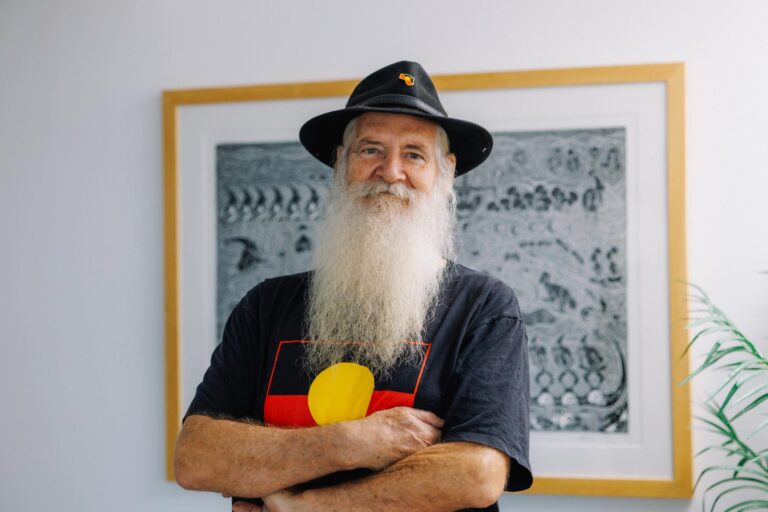
Uncle Joe Sproats reflects on identity, spirit, healing and the journey back to Country
I’m Joe Sproats, a Ngarigo man and Australian South Sea Islander of Lifou ancestry, with Irish and English roots. I was born on Bun Wurrung Country in Melbourne, but like many Aboriginal people, I grew up disconnected from much of my own story. That experience of disconnection has shaped both my personal life and my professional journey.
Recently, I had the opportunity to lead a professional development session at Wakai Waian Healing called Being Aboriginal, the first module in a larger webinar series I’ve developed called Murragari Dhangga, which means learning tribal Lore.
The series has grown out of more than 40 years working as a psychologist alongside Aboriginal and Torres Strait Islander communities, thousands of hours yarning with Elders and community members, and my own ongoing reconnection journey as a Ngarigo man.
One of the first things I shared with staff is that a lot of cultural training focuses almost entirely on trauma and colonisation. Those conversations are important. But I believe we also need to ask a deeper question:
What does it actually mean to be Aboriginal?
Not from a government definition. Not from a checkbox. But from a spiritual, cultural and lived perspective.
One of the central ideas in the presentation was that Country is not just land. Country is alive. It is ancestor, memory and spirit.
I told staff: “Country remembers you, even when you’ve been made to forget.”
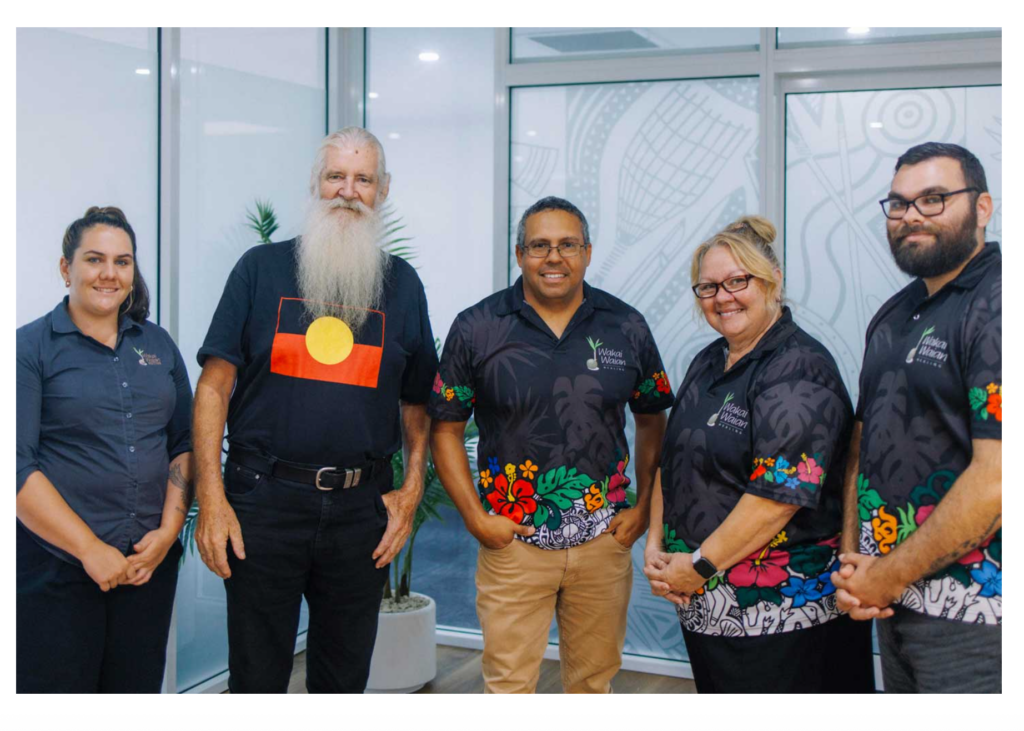 Sharni Upton, Joe Sproats, Ed Mosby (CEO and Founder Wakai Waian Healing) Leah Munns, Jhai Bartley
That line carries a lot of meaning for me personally.
I did not discover my Aboriginal identity until adulthood. Like many families impacted by colonisation, parts of our story had been hidden. There was silence around identity, silence around ancestry, silence around where we came from.
When I finally started tracing my family history, it was not a straightforward process. There was confusion, doubt, resistance and grief. But there was also something deeper happening underneath it all. A kind of knowing.
Looking back now, I can see that Country had been calling me long before I understood why.
As a young man, long before I knew I was Ngarigo, I found myself drawn repeatedly to the Snowy Mountains region, to Ngarigo Country. I hitchhiked there with my wife in the 1970s. Later we honeymooned there. At the time, I had no conscious understanding of why those places felt so significant. But in hindsight, I now understand those experiences differently.
That is what I mean when I talk about spirit.
During my psychology training at Melbourne University in the 1970s, I remember being told there was no place for spirit within psychology. Even then, that never sat right with me. I could not understand how we could talk about healing while ignoring one of the deepest parts of being human.
Over the years, working alongside Aboriginal and Torres Strait Islander communities only strengthened that belief. People often focus on mind and body while neglecting spirit altogether. But without spirit, healing becomes hollow.
That understanding shaped much of my later work through Dreamtime Learning and Dreamtime Counselling and Coaching Service, where I focused on culturally grounded approaches to healing, education and reconnection.
In the PD session, I spoke about the layers of Aboriginal identity. Identity is not just legal recognition. It is spiritual, cultural and relational all at once.
I explained that there are deeper layers beneath the surface: Dreaming connections. Totem lineage. Songlines. Kinship. Lore. Responsibility. Community.
Those deeper layers are often invisible, but they are the strongest.
One of the most important concepts I wanted staff to understand was that late identity is not fake identity.
Many Aboriginal people reconnect later in life because their history was deliberately hidden or severed through policies of removal, assimilation and survival. That does not make their identity less real. Reconnection takes courage.
Sometimes it begins with finding an old photo. Sometimes with hearing a surname. Sometimes with a feeling that cannot quite be explained. Sometimes by standing barefoot on Country and crying without understanding why. That, too, is ceremony.
One of the strongest moments in the session came when staff began reflecting on their own journeys. One staff member shared emotionally about travelling back to Gubbi Gubbi Country with her sister after years of searching for answers about their family history. She described finally feeling peace, even without knowing everything.
That conversation captured exactly what this work is really about. Not perfection. Not performance. Connection.
Another key part of the session focused on responsibility. I explained that being Aboriginal is not just about pride. It is also about obligation. Responsibility to mob. Responsibility to Country. Responsibility to Lore. Responsibility to future generations.
Culture is not a costume or performance. It lives in how we walk, listen, speak, grieve and care for one another. It lives in Dadirri, deep listening. It lives in respecting Elders.It lives in collective healing.
Throughout my career, whether establishing the first Torres Strait Islander Disability Service, working in disability advocacy, or supporting Aboriginal communities through counselling and education, I have come back to the same understanding again and again:
Healing happens through reconnection.
Reconnection to spirit.
Reconnection to Country.
Reconnection to culture.
Reconnection to each other.
That is why these conversations matter so deeply.
At Wakai Waian Healing, our PD sessions are not simply about professional knowledge. They are spaces where people can reflect, reconnect and deepen their understanding of themselves, each other and the communities we walk alongside.
As I told staff at the close of the session: “Every Aboriginal person has a place in the circle, including late identifiers.”
And sometimes the journey home begins simply by recognising that Country has been waiting for you all along.